
Why syringe and needle choice matters
When working with reconstituted research peptides, the syringe and needle are the tools used to add diluent and to draw accurate, repeatable measurements. The right choice makes measurement precise and handling clean, while the wrong choice can make small volumes hard to measure or risk damaging the peptide. This guide covers the practical considerations researchers weigh when selecting them.
This article is a practical handling reference for laboratory researchers. All peptides and related supplies sold by Prime Peptide Solutions are for in-vitro research only and not for human consumption.
Background: Reading a Syringe
Syringe volume and unit markings
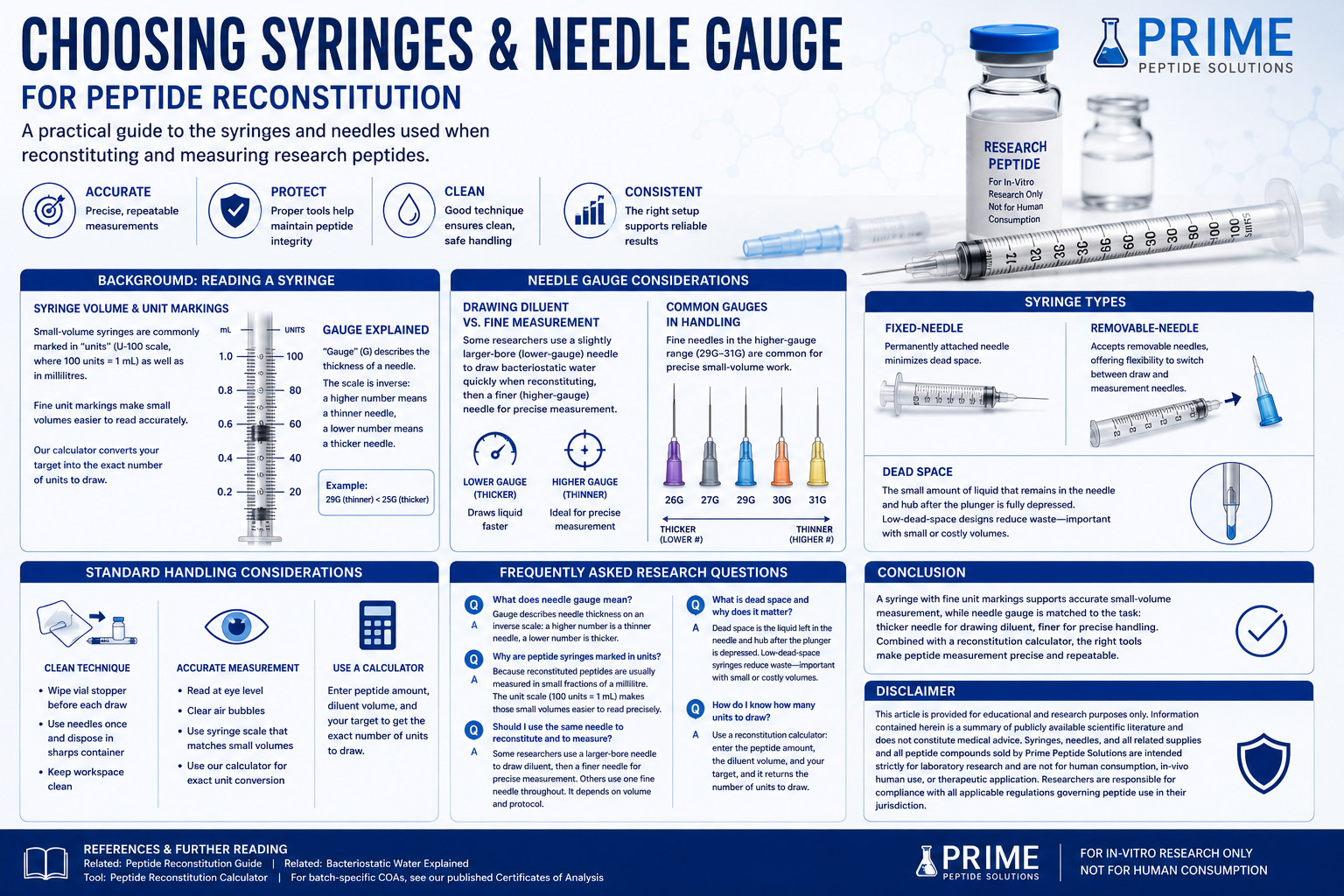
Small-volume syringes are commonly marked in "units" (the U-100 scale, where 100 units equals 1 mL) as well as in millilitres. Because reconstituted peptides are often measured in small fractions of a millilitre, a syringe with fine unit markings makes those small volumes easier to read accurately. Our reconstitution calculator converts a target amount into a number of units on the syringe for a given reconstitution ratio.
Gauge explained
"Gauge" (G) describes the thickness of a needle. The scale is inverse: a higher gauge number means a thinner needle, and a lower number means a thicker one. For example, a 29G needle is thinner than a 25G needle.
Needle Gauge Considerations
Drawing diluent vs. fine measurement
Some researchers use a slightly larger-bore (lower-gauge) needle to draw bacteriostatic water quickly when reconstituting, then a finer (higher-gauge) needle for precise measurement work. A thicker needle moves liquid faster; a thinner needle suits delicate, accurate handling.
Common gauges in handling
Fine needles in the higher-gauge range (such as 29G to 31G) are common for precise small-volume work, while a lower gauge may be used purely for the reconstitution draw. The exact choice depends on the volumes involved and the preferences of the protocol.
Syringe Types
Fixed-needle vs. removable-needle
Some small-volume syringes have a permanently attached needle, which minimizes dead space (the small volume of liquid left in the hub). Others accept removable needles, which offers flexibility to switch between a draw needle and a measurement needle on the same syringe barrel. Each has trade-offs in convenience and measurement precision.
Dead space
Dead space is the small amount of liquid that remains in the needle and hub after the plunger is fully depressed. Low-dead-space designs reduce this, which matters most when working with very small or expensive volumes.
Standard Handling Considerations
Clean technique
The vial stopper is typically wiped before each draw, and needles are used once and disposed of in an appropriate sharps container. Keeping the work area and tools clean protects the integrity of the reconstituted solution.
Accurate measurement
Reading the syringe at eye level, clearing air bubbles, and using a syringe whose scale matches the small volumes involved all support accurate, repeatable measurement. Pairing the syringe scale with the reconstitution calculator removes guesswork from converting a target amount into a number of units.
Frequently Asked Research Questions
What does needle gauge mean?
Gauge describes needle thickness on an inverse scale: a higher number is a thinner needle, a lower number is thicker.
Why are peptide syringes marked in units?
Because reconstituted peptides are usually measured in small fractions of a millilitre. The unit scale (100 units = 1 mL) makes those small volumes easier to read precisely.
Should I use the same needle to reconstitute and to measure?
Some researchers use a larger-bore needle to draw diluent quickly during reconstitution, then a finer needle for precise measurement. Others use one fine needle throughout. It depends on the volumes and the protocol.
What is dead space and why does it matter?
Dead space is the liquid left in the needle and hub after the plunger is depressed. Low-dead-space syringes reduce waste, which matters most with small or costly volumes.
How do I know how many units to draw?
Use a reconstitution calculator: enter the peptide amount, the diluent volume, and your target, and it returns the number of units to draw on the syringe.
Conclusion
Choosing syringes and needles is a practical but important part of working with research peptides. A syringe with fine unit markings supports accurate small-volume measurement, while needle gauge is matched to the task: a thicker needle for drawing diluent, a finer one for precise handling. Combined with a reconstitution calculator, the right tools make peptide measurement precise and repeatable.
Disclaimer: This article is provided for educational and research purposes only. Information contained herein is a summary of publicly available scientific literature and does not constitute medical advice. Syringes, needles, and all related supplies and all peptide compounds sold by Prime Peptide Solutions are intended strictly for laboratory research and are not for human consumption, in-vivo human use, or therapeutic application. Researchers are responsible for compliance with all applicable regulations governing peptide use in their jurisdiction.
References & Further Reading
- Related: Peptide Reconstitution Guide
- Related: Bacteriostatic Water Explained
- Tool: Peptide Reconstitution Calculator
- For batch-specific COAs, see our published Certificates of Analysis
Syringes for Laboratory Work
We carry Insulin Syringes suited to the small-volume measurement described above. For dilution calculations, see our peptide calculator.
Sold strictly for in-vitro laboratory research. Not for human or animal consumption.