
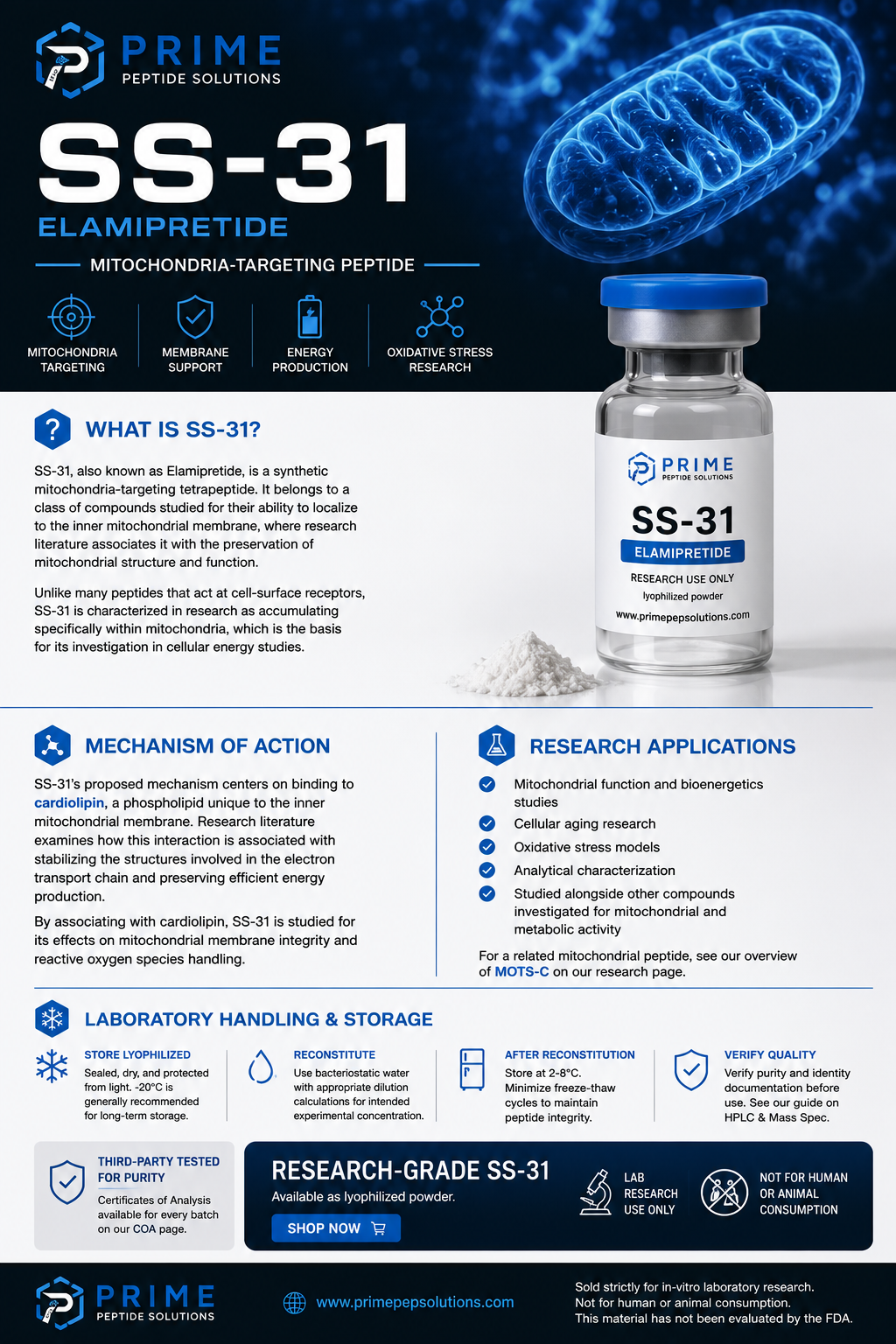
What is SS-31?
SS-31, also known as Elamipretide, is a synthetic mitochondria-targeting tetrapeptide. It belongs to a class of compounds studied for their ability to localize to the inner mitochondrial membrane, where research literature associates it with the preservation of mitochondrial structure and function.
Unlike many peptides that act at cell-surface receptors, SS-31 is characterized in research as accumulating specifically within mitochondria, which is the basis for its investigation in cellular energy studies.
This article is intended as a scientific overview for laboratory researchers. All compounds discussed are sold strictly for in-vitro research and are not for human consumption.
Discovery and Background
SS-31 is part of the Szeto-Schiller (SS) family of peptides, named for the researchers who developed them. It was designed with an alternating aromatic-cationic structure that research literature associates with its selective accumulation in mitochondria.
Mechanism of Action
SS-31's proposed mechanism centers on binding to cardiolipin, a phospholipid unique to the inner mitochondrial membrane. Research literature examines how this interaction is associated with stabilizing the structures involved in the electron transport chain and preserving efficient energy production. By associating with cardiolipin, SS-31 is studied for its effects on mitochondrial membrane integrity and reactive oxygen species handling.
Research Applications
SS-31 is examined in preclinical and in-vitro research including mitochondrial function and bioenergetics studies, cellular aging research, oxidative stress models, and analytical characterization. It is frequently studied alongside other compounds investigated for mitochondrial and metabolic activity. For a related mitochondrial peptide, see our overview of MOTS-C.
Laboratory Handling and Storage
SS-31 is supplied in lyophilized (freeze-dried) form. Store the lyophilized powder sealed, dry, and protected from light; -20°C is generally recommended for long-term storage. Reconstitute with bacteriostatic water using appropriate dilution calculations for the intended experimental concentration — see our reconstitution guide for detailed ratios. Once reconstituted, store at 2-8°C and minimize freeze-thaw cycles, which contribute to peptide degradation. Verify purity and identity documentation before use; see our overview of how peptide purity is verified.
Research-Grade SS-31
In our catalog, SS-31 is available as SS-31, supplied as a lyophilized powder and third-party tested for purity. Certificates of Analysis are available for every batch on our COA page.
Sold strictly for in-vitro laboratory research. Not for human or animal consumption. This material has not been evaluated by the FDA.